
Clear communication sits at the center of every successful corporate event. In the United States, organizations increasingly work with diverse audiences that include Nepali-speaking employees, partners, and stakeholders. Language differences can create confusion, slow down decision-making, and reduce engagement if not handled properly.
Conference interpretation solves this challenge by enabling real-time communication across languages. It allows speakers to present naturally while audiences receive accurate translations instantly. Whether the setting is a corporate summit, training session, investor meeting, or internal workshop, professional interpretation ensures that no participant is left out of the conversation. Organizations that invest in high-quality interpretation services not only improve communication but also strengthen trust, professionalism, and global reach.
What Conference Interpretation Means in a US Corporate Context
Conference interpretation refers to the process of converting spoken language from one language to another in real time during formal events. Unlike casual or ad hoc interpreting, conference interpretation requires a high level of precision, concentration, and subject matter familiarity. Interpreters must listen, process, and deliver meaning almost instantly while preserving tone, intent, and technical accuracy.
In a corporate environment, interpretation supports a wide range of use cases. These include leadership meetings, training programs, compliance briefings, product launches, and cross-border collaborations. It enables organizations to operate efficiently in multilingual environments without forcing participants to rely on limited language skills. As businesses expand globally and engage with diverse communities, conference interpretation becomes a critical operational tool rather than an optional service.
Organizations comparing different interpreting formats can explore over-the-phone interpretation (OPI) services to understand how conference interpretation differs from remote phone-based solutions.
For a broader industry definition, refer to International Association of Conference Interpreters (AIIC), which outlines professional standards and practices.
Types of Conference Interpretation Used by US Organizations
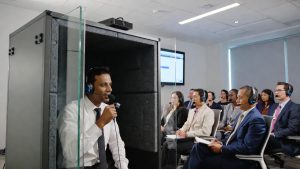
Simultaneous interpretation is the most widely used method in large conferences and corporate events. In this setup, interpreters work from soundproof booths and deliver translations in real time while the speaker continues talking. Participants listen through headsets, allowing seamless communication without interruptions. This method works well for large audiences, panel discussions, and multilingual events where time efficiency is important.
Consecutive interpretation is used in smaller or more interactive settings. The speaker pauses after a segment, and the interpreter delivers the translation. This approach is common in executive meetings, negotiations, and training sessions where accuracy and clarity are prioritized over speed. It allows for more controlled communication but takes more time.
Remote and hybrid interpretation have become increasingly common. Platforms such as Zoom and Microsoft Teams now support multiple language channels, allowing interpreters to work from different locations. This approach reduces travel costs and increases flexibility, making it a practical option for organizations managing distributed teams or global audiences.
Why US Organizations Need Nepali Conference Interpreters
The need for Nepali conference interpreters has grown steadily across the United States. Organizations in healthcare, education, workforce development, and corporate sectors frequently interact with Nepali-speaking individuals. Without proper interpretation, communication gaps can affect both efficiency and outcomes.
Providing professional interpretation services demonstrates a commitment to inclusion and accessibility. It allows organizations to engage more effectively with their audience, build stronger relationships, and ensure that important information is clearly understood. In many cases, it also supports compliance with federal and state language access requirements.
Growing Nepali-Speaking Audience in the US
The Nepali-speaking population in the United States has expanded significantly over the past decade. This growth includes Bhutanese refugee communities as well as skilled professionals working in various industries. As a result, many organizations now encounter Nepali language needs in corporate training sessions, community outreach programs, and workplace communication.
According to U.S. Census Bureau data, language diversity continues to grow, reinforcing the importance of multilingual communication strategies.
Companies that recognize this shift can improve their communication strategies by incorporating language support. Providing Nepali interpretation helps employees and stakeholders feel included and valued. It also reduces misunderstandings and increases participation during important discussions. In a competitive business environment, effective communication with diverse audiences can become a key differentiator.
Business Risks of Poor Interpretation at Conferences
Poor interpretation can create serious risks for organizations. Miscommunication during a conference or meeting can lead to incorrect decisions, failed negotiations, or confusion among participants. In high-stakes environments, even small errors can have significant consequences.
There are also compliance considerations. Under Title VI of the Civil Rights Act, organizations that receive federal funding must provide meaningful language access.
You can explore real-world consequences in translation errors that caused delays, which highlights how small language errors can lead to costly delays.
Key Features of Professional Conference Interpretation Services
Accuracy, Speed, and Subject Matter Expertise
Accuracy is one of the most important aspects of conference interpretation. Interpreters must convey the exact meaning of the speaker without adding or omitting information. At the same time, they must deliver translations quickly to keep up with the pace of the event.
Subject matter expertise plays a critical role in achieving this balance. Corporate events often include technical discussions related to finance, healthcare, law, or operations. Interpreters who understand these topics can handle specialized terminology more effectively.
To understand the importance of certification and expertise, refer to why certified Nepali interpreters matter.
You can also review professional certification standards from the American Translators Association (ATA).
Equipment and Technical Setup Requirements
High-quality interpretation depends on proper technical setup. For simultaneous interpretation, soundproof booths, microphones, transmitters, and headsets are required to ensure clear communication.
In remote or hybrid settings, reliable technology becomes even more important. Stable internet connections, high-quality audio, and well-configured platforms are essential for maintaining interpretation quality.
For technical guidelines, refer to ISO standards for interpreting services.
How to Hire a Nepali Conference Interpreter in the US
Evaluating Interpreter Credentials and Experience
Fluency in both languages is only the starting point. Professional interpreters often have formal training, certifications, and experience in specific industries.
Organizations should follow a structured approach like this guide on how to hire a Nepali interpreter in the USA.
Working with Interpretation Vendors vs Freelancers
Freelancers may be suitable for smaller events, but vendors provide reliability, scalability, and project management support.
Learn more from Globalization and Localization Association (GALA).
Future of Conference Interpretation in the US Market
Role of AI and Human Interpreters
AI tools can assist with basic translation but struggle with nuance and context.
A deeper comparison can be found in human translation vs AI.
Choosing the Right Conference Interpretation Partner
Conference interpretation plays a critical role in corporate communication. It enables organizations to operate effectively in multilingual environments and engage diverse audiences.
Choosing the right partner improves clarity, reduces risk, and strengthens relationships. Organizations that invest in professional Nepali interpreters gain a long-term advantage in communication, compliance, and global business operations.